
The timeless psychology behind our drive to dream and belong.
Typically, we think that logic guides our choices and that we choose what we desire, whenever we like. However, if you examine more carefully, underneath every aspiration, every purchase, every connection, something considerably more profound is at work, a whole pattern of human demands guiding our decisions. This is precisely where Maslow’s Hierarchy of Needs comes into play, a framework that quietly explains practically all of why we act as we do.
In 1943, psychologist Abraham Maslow started a paradigm that would permanently alter our views of motivation. From fundamental survival instincts to more advanced emotional and cognitive goals, he forcefully argued, human behaviour is comprised of layers. The more one layer is fulfilled, the more we naturally seek the next objective. This pyramid of needs became one of the stepping stones of human motivation psychology, shaping nearly from therapy and marketing to leadership and education. Let’s unfold and see how it all fits together, and why even decades later, Maslow’s hierarchy still defines the rhythm of modern life.
The Origin of Maslow’s Hierarchy of Needs
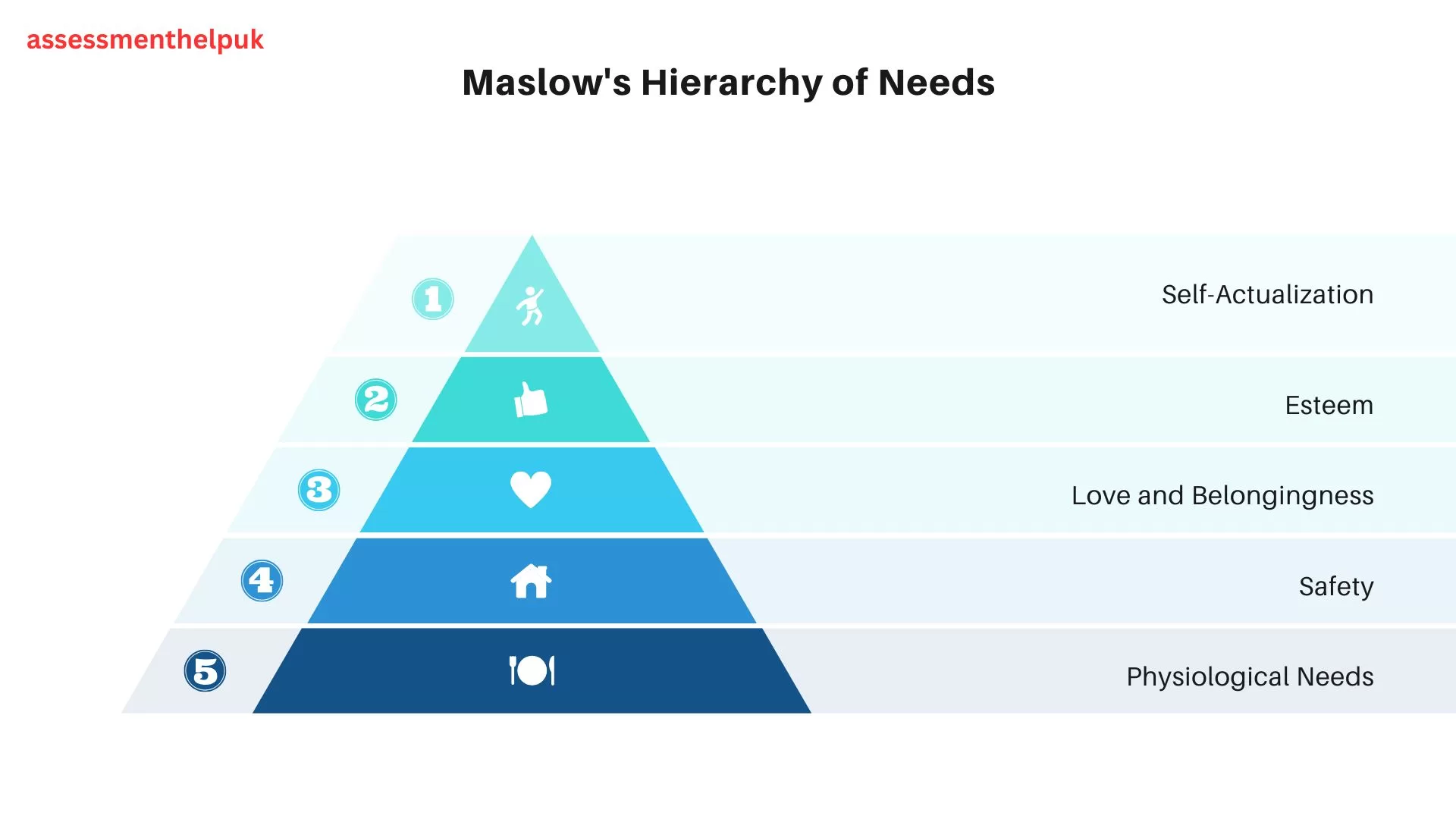
The theory came into existence with a simple motto: what really motivated people beyond survival? Maslow saw that once a basic need was met, they craved for emotional and personal growth. To which he proposed a five-tier model, which is often seen as a pyramid, with foundational needs right at the bottom and self-fulfilment straight at the top. Every one of them is a stepping stone; you rise more as your past ones are met and happy.
Analysing the Five Levels of Human Motivation
Separating the five levels will enable one to better understand Maslow’s inspirational theory:
- The basics: food, drink, sleep, and shelter are all physiological requirements.
- Financial safety, stability, and defence.
- Love and Belonging: Friendships, relationships, social ties.
- Esteem calls for recognition, self-worth, and respect.
- Self-Actualisation: the desire to live one’s purpose and reach one’s potential.
Every level serves as fuel; once you have enough of one, you are naturally pulled toward the next.
How Maslow’s Hierarchy of Needs Works in Practice
The real essence of Maslow’s Hierarchy of Needs is in its simplicity; it shows how we grow as an individual personality. Where each level shows a natural progression of human state and desire, starting from physical survival and rising all the way to self-actualisation. But Maslow never meant it to be a strict ladder where you can’t make a move unless a step is completed. In reality, people do move up and down the hierarchy, depending on their circumstances.
For instance, you may be successful in your career (fulfilling your esteem needs) but might feel disengaged from your relationships. Or you must be having a strong social circle support, yet you find yourself struggling with financial insecurity. Maslow’s insight was that motivation changes dynamically; our priorities shift as our needs are being met or threatened.
This flexible structure is what makes the Maslow motivation theory so timeless. It doesn’t just describe behaviour, it tells the reason behind it. Businesses use it to understand consumers’ psychology, teachers implement it to inspire students, and therapists use it to identify emotional blockages. Essentially, it gives much better context to the human condition, a solid map of what really matters at every stage of life.
The Pyramid in Motion: From Survival to Growth
To make it more connected, think about motivation as a cycle rather than a staircase. Once your basic necessities are fulfilled, like shelter, food, and water, your mind transcends looking upward, seeking validation and meaning. This shift shows the transition from basic needs to growth needs, which results in personal development.
It’s this exact moment that defines surviving to thriving, that drives progression. A person looking for stability works very hard for a decent income. Once they get that, they seek to make connections, once connected, they want to achieve, and once accomplished, they search for the intent. Understanding this motion isn’t just academic; it’s practical. It shows you how to identify where you currently stand in your own hierarchy and what’s going to be your next move.
The Deeper Layers of Motivation: Exploring the Psychological Needs Hierarchy
Once you look above the surface of Maslow’s Hierarchy of Needs, you get to see that it’s more than just a list; it’s a mirror of how the human mind grows with fulfilment, with each stage revealing not only what we like to see but also what we actually feel when those certain needs are fulfilled or left unattended. This inner structure, often called the psychological needs hierarchy, fosters the integral structure of every decision that we make.
Maslow divided the hierarchy into two main categories: deficiency needs and growth needs.
- Deficiency needs
Comes from the absence of something that’s essential. If you lack safety, love, or even esteem, you’d be feeling tension and restlessness until and unless you get the balance.
- Growth needs
Usually found at the top of the pyramid, don’t come from a void; they arise from a strong desire to become more in order to reach your true potential.
How Each Level Shapes Human Behaviour
This progression doesn’t mean that everyone reaches the pyramid at the same speed; various uncertainties from relationships to losing jobs can either push up or push down. But the psychological rhythm stays constant: Once a lower-level need is fulfilled, the urge to grow returns is much stronger than ever. To understand this better, let’s see some of the similar scenarios that we almost encounter in our daily lives:
- Physiological and Safety Needs: Financial stability takes priority for a student who is working part-time solely to meet rent and meals over long-term objectives.
- Once they have reached some degree of stability, that same student could look for closer friends or classroom honours.
- Self-Actualisation: Eventually, they begin dreaming bigger, maybe starting a business, mentoring others, or investigating something they love, once their surroundings seem secure and encouraging.
Why it matters
Every single person is obsessed with speed and success. Maslow here constantly tells us that real motivation comes slowly and is layered. When we stop to identify which of our needs are unmet, we get much clarity on why we feel constantly stuck or even restless at times. Self-awareness is the legitimate first step towards having a balanced personality while sustaining professionalism.
Understanding Self-Actualisation Theory
At the very top of Maslow’s Hierarchy of Needs, there exists a stage that is above survival or recognition, the end pursuit of one’s highest potential, and this is what self-actualisation theory is all about: Letting that inner drive out to become the most authentic version of yourself. Self-actualisation, according to Maslow, is “the urge to become more and more what one is, to become everything one is always able to become.” Unlike the low-end demands, which are usually triggered by deficits, this condition is motivated by development, inventiveness, curiosity, and a sense of direction.
What Does Self-Actualisation Look Like in Real Life?
It’s not limited to mass achievements or fame; sometimes it’s subtle, a teacher designing new ways to inspire her students, an artist painting for self-expression, or even a student conducting research into ideas that could help others. On the contrary, self-actualisation is all about doing something which aligns with your true self, not what society actually expects from you.
People who reach this stage tend to have the same qualities, such as authenticity, independence, compassion, and a constant desire to learn something new. They’re highly motivated and energetic, which is a sign that their hierarchy has reached the optimal point, along with their inner satisfaction.
Maslow’s Relevance in Modern Life
Even looking at it now, Maslow’s ideology has shaped how we understand human potential in workplaces and education, something that we will see further in How Maslow’s Hierarchy Shapes Modern Workplaces and Education. Schools teach more about emotional growth, not just the typical academic success.
This shift shows a universal truth: Once people feel secure, valued, and connected enough, they don’t just perform; they flourish effortlessly. And that’s what Maslow predicted years ago, when the motivation is at its highest, it transforms from chasing needs to realising possibilities.
Beyond the Pyramid: A Reflection on What Drives Us
Every decision, every ambition, connects back to one thing: the need to meet our needs and transcend them when you strip life down to its essential nature. That’s exactly what Maslow’s Hierarchy of Needs catches so beautifully. It mirrors who we are at every point in our lives, not just a psychological model.
First, we look for consolation, then security, then belonging; finally, we aim for significance. It’s a pattern that recurs throughout life, reminding us that drive is cyclical rather than linear. One met need always begs the follow-up: What now?
From Needs to Purpose: What Maslow Still Teaches Us
Understanding this hierarchy clarifies whether you are developing a job, cultivating relationships, or rediscovering your life’s goal. It clarifies not only what you’re after but also why. Ultimately, the aim is not just to scale the pyramid. It is to seek balance within it where growth, appreciation, and direction finally coincide.
FAQs
1. Briefly described, what is Maslow’s Hierarchy of Needs?
It’s a psychological model showing how humans move from fulfilling basic survival needs to attaining personal development and self-actualization.
2. Maslow’s Hierarchy is useful in daily life mostly because of its
From seeking safety and love to pursuing career aspirations or creative satisfaction, it clarifies why we choose certain paths.
3. Maslow’s ideas connect to mental health in what way?
Often resulting in stress, anxiety, or lack of motivation is an unmet lower-level need, such as security or belonging.
4. Over time, may Maslow’s Hierarchy of Needs evolve?
Yes, priorities change based on life stages, culture, and individual events, hence the hierarchy is dynamic rather than static.
5. Modern businesses make use of Maslow’s Hierarchy in what ways?
Employers use it to create supportive environments that satisfy both emotional and professional needs, therefore enhancing motivation and retention.
6. Self-actualisation examples today include which one?
It might be someone following a passion project, founding a company, or allocating time to personal development beyond financial success.

