
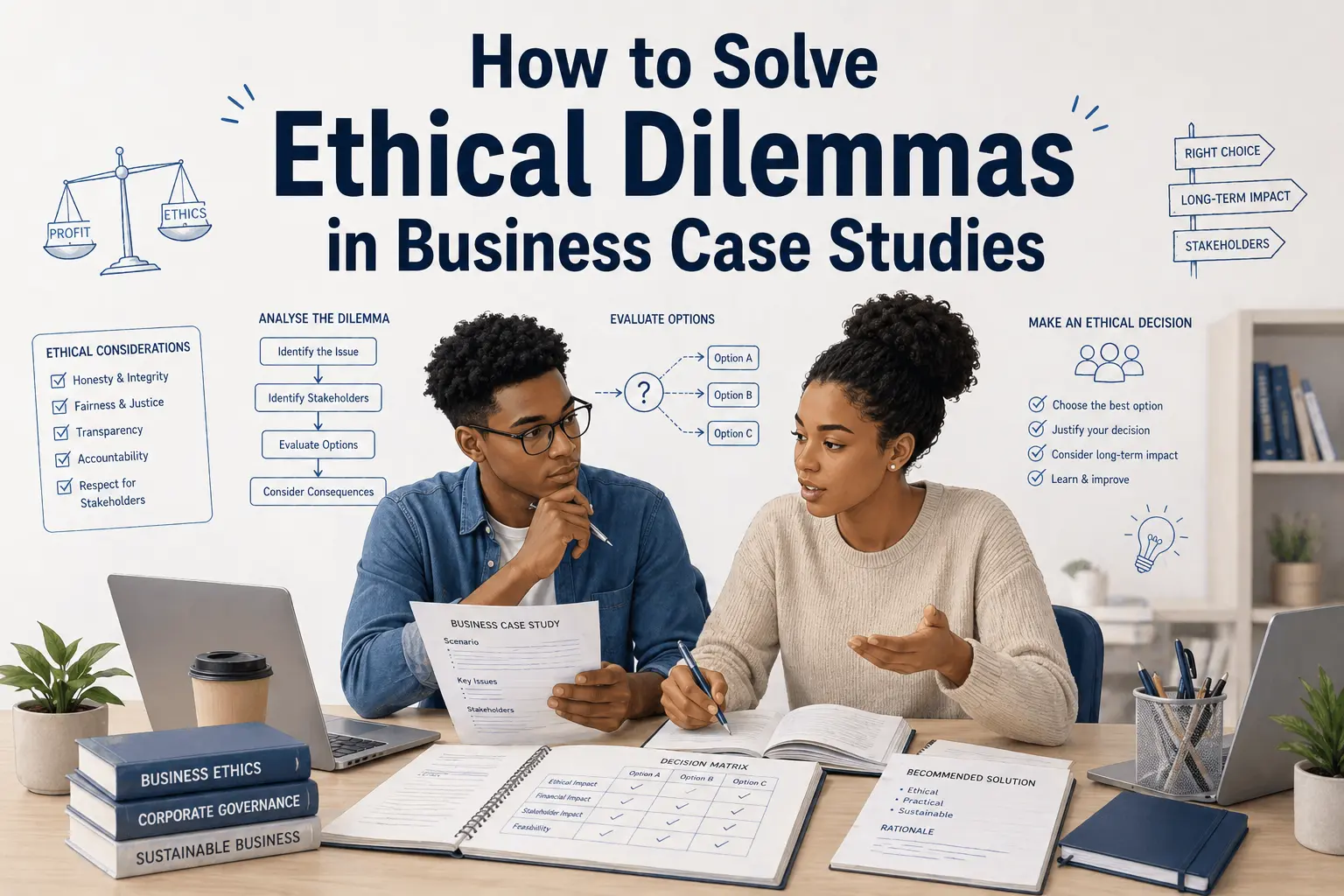
As discussed previously in one of our blogs about how to analyse ethical dilemmas in business assignments, we saw how companies balance profit with their core objective.
Having a look at that, this blog strives on the practical application of those values.
We will look at how to approach a business case study when you face a much tougher choice.
When a candidate looks for a business assignment helper, they find that the hardest part isn’t the theory yet, but rather applying it.
The Initial Case Deconstruction
Right before you start solving the problem, you should be able to identify its root cause.
Business case studies usually include points that might seem interesting, but they still miss the ethical core.
Identify the “Moral Point of Impact”
Every dilemma has a moment where a decision should be made that will hurt someone or violate a principle. Ask yourself:
- Is there a conflict between two core values (e.g., Transparency vs. Privacy)?
Map the Power Dynamics
In business ethics, the individual facing the dilemma lacks complete power. Knowing who holds the power is important. If you’re looking for help with business assignment tasks, a professional will suggest that you create a power-interest matrix for characters in the case.
This helps you understand why an employee might feel pressured to act unethically. Is the pressure coming from a direct supervisor, or is it systemic within the company culture?
The Stakeholder Analysis (The Who)
A business dilemma is never solved in a vacuum; every choice has its own effect. To solve a case study more effectively, you should dive ahead and see from the affected parties. A top-quality response doesn’t just list stakeholders randomly; it assesses their vulnerability.
- Primary Stakeholders: This group experiences the direct effects of the company’s actions. It includes employees at risk, customers using a default product, and shareholders watching their investment.
- Secondary Stakeholders: These include the local community (economic impact), the environment (long-term sustainability), and future generations.
- Marginalised Voices: Look for the groups in the case study who have no say in the decision but bear the most risk. For instance, if a factory is polluting a river, the local residents who don’t work for the company are marginalised stakeholders.
Applying Ethical Lenses (The Why)
The Utilitarian Lens (Consequences)
This approach focuses on the outcome. You should be able to calculate which decision results in the greatest good for the greatest number of people.
- The Methodology: List Option A and Option B. For each, assign a utility value to each stakeholder. If Option A helps 1,000 people but ruins the life of 1 person, Utilitarianism usually says to move ahead.
- The Critique: When writing your assignment, mention the Calculation Problem.
The Deontological Lens (Duty and Rules)
This approach neglects the results and focuses on the action itself. Is the action right or wrong based on universal rules?
- The Methodology: Ask: “Would I want this action to become a universal law?” If everyone lied on their financial stats, the global economy would collapse.
- The Business Context: This is the basis of Compliance and Legal Departments.
The Virtue Ethics Lens (Character)
- The Methodology: Look at the company’s mission statement. Does the action align with the virtues of integrity, honesty, and courage?
- The Business Context: This is extremely important for brand management. A company that works with virtue builds moral capital that protects it during future crises.
When using a business assignment helper, make sure they help you understand and know the difference between these theories.
The Evaluation of Alternatives (The Third Way)
A common mistake in case studies is only looking at the two options, such as “do it” or “don’t do it”. Real-world business solutions usually involve creative synthesis.
Strategy 1 – The “Grand Compromise”
Can you get 80% of the financial goal while sustaining 100% of the ethical standard?
- Example: if one product is under-performing but not dangerous, instead of going with a total recall, can you offer a voluntary upgrade program?
Strategy 2 – The “Process Improvement”
Usually, an ethical dilemma is a sign of a broken process.
- Analysis: If the sales representatives are cheating on their reports, don’t just fire them directly. Look at the structure given for the incentive. Are quotas impossible to reach? Your recommendation should be able to include changing the system that led to temptation.
Strategy 3 – The “Transparency Pivot”
When in doubt, sunlight is the best disinfectant. A common third way is to go public with the problem before a whistleblower does, allowing the company to control the narrative and demonstrate accountability.
The “Stress Test”
Right before you finalise your recommendation, you need to put it under a series of tests to see if it holds up under pressure or not.
Many students find that Assessment Help UK provides the best guidance for these “stress tests,” as they require a level of objectivity that is hard to maintain when you are deep in the writing process.
- The Publicity Test: Will you be comfortable if your decision-making were kept in front of the Wall Street Journal tomorrow? Will you take accountability?
- The Mirror Test: Can you look at yourself in the mirror and feel proud of the choice? Does it align with your personal values as a future leader?
- The Professional Code Test: Does this decision violate the specific codes of conduct for your industry (e.g., AICPA for accountants, CFA standards for finance)?
- The Reversibility Test: If you were the stakeholder being negatively impacted by this decision, would you still think the logic behind it is fair?
Structuring Your Final Report for Maximum Impact
Follow this structure to ace it:
1. Executive Summary
Briefly describe the dilemma, the primary stakeholders, and your final recommendation. The reader should be able to know your conclusion by the end of the first page.
2. Comprehensive Assessment
The main content of the document exists here. The document requires subheaders that introduce the three lenses of Utilitarian, Deontological, and Virtue. The bullet points should display the advantages and disadvantages of various options. The structure you created enables the grader to read your reasoning and actual proof.
3. The Recommendation and Implementation
Don’t just say what to do; say how to do it. This section should include:
- Immediate Actions (24-48 hours): Who needs to be called?
- Short-term Goals (1-3 months): What policies need to be rewritten?
- Long-term Monitoring: How will we ensure this doesn’t happen again? (e.g., appointing an Ethics Officer).
4. Communication Strategy
If you are letting someone go for unethical behavior, how do you tell the team? How do you keep morale up without breaking privacy laws?
If you need help with business assignment, focus on the “Communication” part.
Final Checklist for Success
- Analyse: Have I used at least two or three ethical frameworks?
- Balance: Have I considered the financial and operational impact on the company?
- Justify: Have I explained why my chosen path is the best one using evidence?
- Implementation: Have I provided a step-by-step plan for the first 90 days?
Conclusion
Resolving an ethical dilemma is rarely a matter of choosing between right and wrong; it’s the difficult art of surfing right vs right scenarios where core values conflict. To have a solid solution that stands up to scrutiny, one should go beyond one’s gut feeling and implement a structured synthesis of framework and personal character.
Weighing the consequences for stakeholders against universal moral duties, we change the moment of crisis into a disciplined exercise of professional judgment.
For students and professionals alike who are facing a challenging academic landscape, online support such as Assessment Help UK provides complete assistance with expert insight and support, helping individuals to understand the operations of ethical frameworks and their practical application. This commitment to principled action is what ultimately defines a mature and reliable decision-maker in a complex world.
