
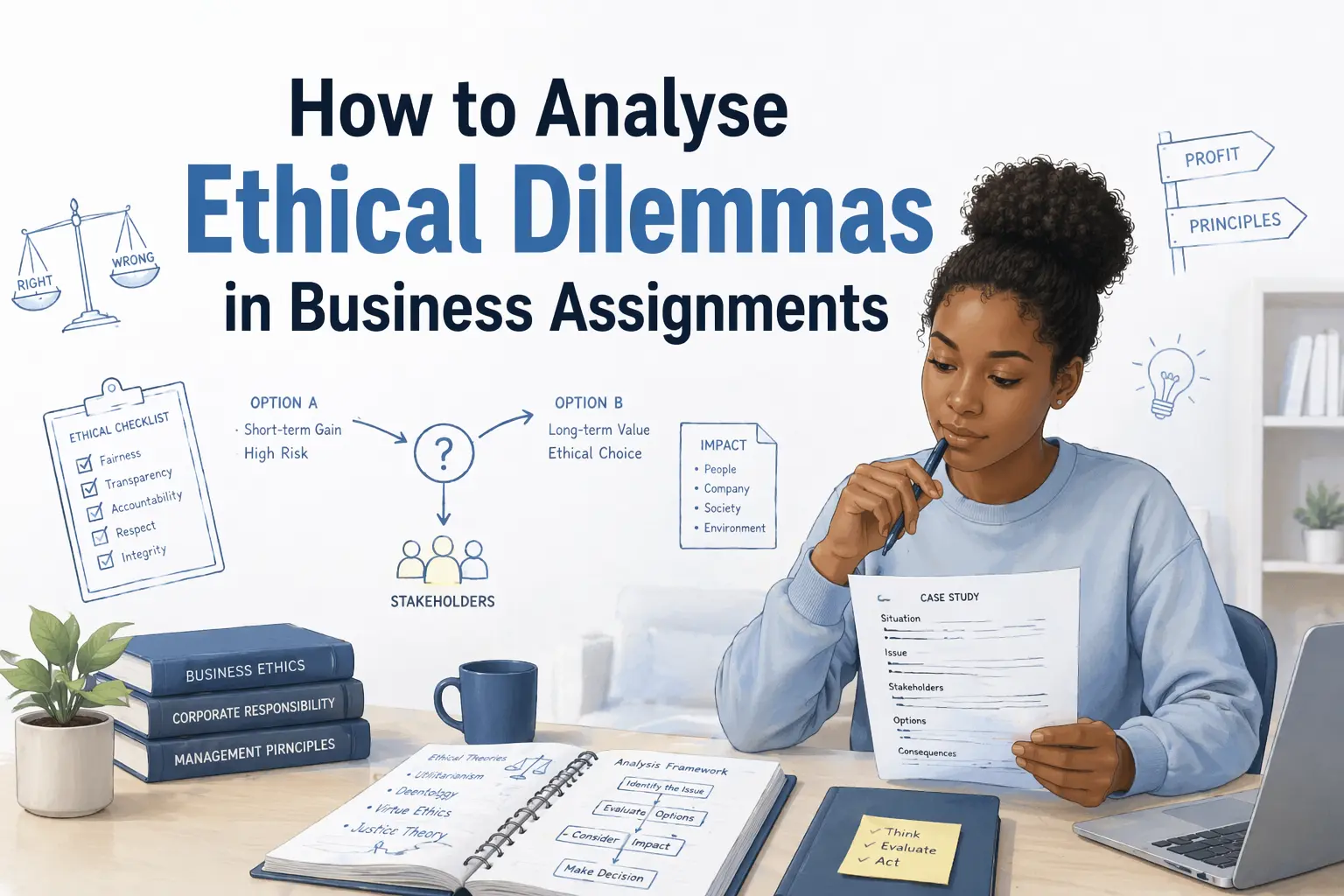
Judging ethical dilemmas is the stepping stone of a modern business education. As corporations face increasing scrutiny regarding their social, environmental, and governance (ESG) impacts, students should show more than just basic knowledge of profit and loss.
You should be able to show that you can navigate the “red-zone” of professional life where legal compliance and obligations usually collide.
A high-scoring business assignment helper doesn’t just identify an ethical problem; it subjects it to critical assessment. This needs a transition from descriptive writing, more than stating what happened, which uses technical analysis to justify a specific piece of action.
The Taxonomy of Ethical Conflict
In order to start an analysis, one should categorise the effect. The majority of the corporate ethical issues fall into four major primary quadrants.
A. Individual vs. Community
This usually happens when the rights or needs of a single person (such as the CEO’s privacy) clash collectively with the company’s reputation or public safety.
B. Short-term vs. Long-term
Usually spotted in financial reporting, where the pressure to meet quarterly earnings (Short-term) leads to creative accounting that puts the firm’s future at risk.
C. Justice vs. Mercy
Knowing how to apply a strict company policy or account for a particular employee’s difficult personal circumstances.
D. Truth vs. Loyalty
The rising conflict between being honest with outside stakeholders (regulators/customers) and maintaining loyalty to colleagues or the organisation.
If you find it difficult to identify which quadrant a particular case study belongs to, seeking certified help with business assignment expert gives the clarity needed to assess and then solve these problems.
Advanced Philosophical Frameworks for Application
A high effect paper should be more than just a plethora of theories; instead, a high effect paper with the theory is like a case magnifying glass.
I. The Kantian Categorical Imperative
Immanuel Kant stated that we should act only according to the rules that we would want to become universal laws.
- In Practice: If a company thinks it’s good to dump waste in a river once, they should question, “Would I want every company in the world to dump waste in every river?”
- Analysis Point: This signifies the inherent contradiction in the majority of the one-time corporate shortcuts.
II. The Utilitarian Calculus
Jeremy Bentham and John Stuart Mill established that the most ethical decision requires people to select the option that generates the maximum happiness for the largest number of individuals.
- In Practice: A pharma company pricing a life-saving medicine should balance the high profit (which funds future research for the many) against the instant needs of the current sick (the few).
- Assessment Tip: Constantly mentioning the “trolley problem” in a business context is a good way to show this theory. Taking the help of services such as Assessment Help UK helps you find contemporary examples of where this calculus has failed in the tech industry.
III. Social Contract Theory
This theory focuses on the fact that businesses exist only because society allows them to. Therefore, they have an agreement to benefit society.
- Application: When businesses make use of public infrastructure, which includes roads, educational facilities, and legal systems, they have a responsibility to society, which consists of paying taxes and providing equitable job opportunities.
The Three Pillars of Sustainability (Triple Bottom Line)
The ethical reporting standard that organisations currently use is based on John Elkington’s “Triple Bottom Line” (TBL) framework. The text should be divided into smaller sections because it contains excessive information.
Profit (The Economic Bottom Line)
- Guaranteeing long-term financial viability.
- Avoiding predatory pricing and monopolies.
- Equal distribution of wealth among shareholders and workers.
People (The Social Bottom Line)
- Fair ground and wages for workers.
- Diversification and inclusion at the board level.
- Impact on the local community (e.g., sourcing from local farmers).
Planet (The Environmental Bottom Line)
- Reducing the carbon footprint.
- Sustainable sourcing of raw materials.
- Adhering to “Circular Economy” principles to reduce waste.
Going through these three major pillars is difficult. A business assignment helper can be instrumental in showing you how to keep certain distinctions rather than letting them conflict with a written report.
Ethical Leadership and Corporate Culture
Ethics functions as a code of conduct that must be followed by people within organisations. The section demonstrates how leadership functions as a force that determines how people will act.
The “Tone at the Top”
If the owner focuses and speaks more about winning at all costs, employees are most likely to cut corners and work without showing much efficiency. Conversely, a leader who admits mistakes encourages transparency.
Formal vs. Informal Systems
- Formal: Codes of conduct, ethics hotlines, and mandatory training.
- Informal: The “water cooler” talk, unwritten rules, and how people are actually promoted.
Key Question for Assignments: Does the company’s formal code of conduct match the informal attitude? If you’re facing trouble finding the internal data to prove this, seeking professional help with business assignmentresources often has access to corporate databases and employee reviews that reveal the “real” culture.
Global Supply Chain Ethics
A company functions as the worldwide economic system operator, which holds responsibility for all activities that occur inside its supply chain system until the fifth operational layer.
The Problem of Outsourcing
The majority of Western firms outsource their production to avoid severe labor laws. This leads up to:
- Child Labor: Illegal but often hidden in deep supply tiers.
- Environmental Degradation: Lax regulations in developing nations.
- Safety Failures: (e.g., the Rana Plaza disaster).
The Solution – Radical Transparency
Blockchain technology is now adaptive to track every step of a product’s journey. When writing about this, you should judge if this is a genuine move or just a marketing tactic.
Most candidates get in touch with services such as Assessment Help UKto get the right data on which industries, such as fashion or electronics, are currently the most problematic in this regard.
Case Study Framework: Step-by-Step Analysis
When you’re presented with a case study, it’s important that you have this checklist to structure your response and avoid long paragraphs that have no clarity:
- Fact-Finding: What is the core issue? Who are the key players?
- Stakeholder Impact: Use a matrix to identify who gains and who loses.
- Legal vs. Ethical: Is the action legal but unethical? (e.g., tax avoidance).
- Theoretical Application: Apply at least two of the frameworks mentioned above.
- Alternative Solutions: Provide 2-3 different paths the company could have taken.
- Recommendation: Choose the best path and justify it using ethical logic.
Remember, if the sourcing or fact-finding is taking too long, it’s no shame to get in touch with a business assignment helper whocan provide a summary of the case’s most relevant legal and financial details.
The Ethics of Big Data and AI
The newest field of research within business ethics has been established as the current business frontier. Automation implementation by companies creates new challenges that need to be resolved.
Algorithmic Bias
When artificial intelligence systems train on historically biased data, they develop recruitment and lending processes that reflect those same biases.
The result establishes a perpetuating cycle of systematic discrimination that operates through automated processes.
Data Sovereignty
Who owns your data? Do you think it would be ethical for a company to sell your “Digital Shadow” without explicitly informing you of its use?
The Black Box Problem
If an AI makes an unethical decision, who is responsible? The programmer? The CEO? The AI itself? The contemporary ethical systems face a significant obstacle because “diffusion of responsibility” creates this challenge.
Getting help with business assignment experts who specialise in “Tech-Ethics” is recommended if your paper covers these complex topics.
Corporate Social Responsibility (CSR) and Greenwashing
The CSR department is always on target as a “marketing department” activity.
- Greenwashing: Making misleading claims about environmental benefits.
- Pinkwashing: Using Breast Cancer awareness to sell products that might actually be harmful.
- Rainbow-washing: Using LGBTQ+ symbols for profit without supporting the community.
Your work should critically examine whether a company’s CSR report is a true reflection of its values or is being used as a mask for unethical practices.
Strategies for High-Quality Academic Writing
To ensure your work is readable and professional, keep these structural tips in mind:
- Use Active Voice: “The company failed to…” is stronger than “Failure was committed by the company…”
- Avoid “Wall of Text”: Never let a paragraph exceed 6 lines. If it gets too long, split it or use a bulleted list.
- Reference Heavy: For every 200 words, you should have at least 1-2 academic citations.
| Writing Goal | Method | Benefit |
| Clarity | Use Short Sentences | Improves comprehension for the marker. |
| Depth | Apply Two Theories | Demonstrates critical thinking skills. |
| Relevance | Use 2024/2025 Cases | Shows you are up-to-date with trends. |
Conclusion and Summary
The process of examining ethical dilemmas needs a structured method that enables organisations to achieve their business goals while fulfilling their ethical obligations.
The use of philosophical frameworks together with stakeholder impact assessment enables you to create an analysis that meets advanced academic standards.
Your assessment of these obstacles requires you to use critical thinking skills, which prove your ability to lead in contemporary business environments.
