The situation develops when you complete an exceptional academic paper but discover that your additional research materials are completely disorganized. The appendix serves as a secondary element, but it functions as an essential part of a top-tier submission. The system functions as a storage facility that holds extensive information that exceeds the limitations of your primary text but serves as essential proof for your academic work.
The presentation requires you to maintain a professional appearance when you show unprocessed data, interview records, and intricate geographic maps. The organization of your appendix section will determine how well your examiner understands your work and the technical assessment results.
Understanding the rules of supplementary documentation is a vital skill. For many, securing assignment writing help is the most effective way to ensure these final sections meet rigorous university standards.
The Purpose and Function of an Appendix
Appendix works to present background information that supports your main arguments. The core body of your essay or dissertation maintains its focused content through this element, results chapter will lose its ability to show your argument clearly when you present twenty pages of unprocessed survey data. Moving this data to an appendix, you maintain the flow of your writing while still providing complete transparency.
When to Include Supplementary Material
The knowledge you need to understand involves knowing which additional information should be contained in an appendix. You should be selective in order to avoid cluttering your work with irrelevant files. The essential items that you need to present include materials that establish a broader context, yet do not explain your main thesis. The following items usually form this group:
- Raw Quantitative Data: Large spreadsheets or calculation tables.
- Qualitative Transcripts: Full records of interviews or focus groups.
- Visual Evidence: High-resolution maps, original photographs, or detailed diagrams.
- Technical Specifications: Detailed descriptions of equipment or software used in the study.
So if you’re unsure if a document is necessary, looking for appendix writing help can help you provide better clarity. Certified professionals can help you elect between essential evidence and unnecessary “filler” that might distract the marker.
Structural Rules for a Professional Appendix
People frequently make the error of making their final document submission by dumping all their content at the end of their work. An expert appendix requires multiple sections that provide both understandable information and organized content to create a complete system. The system requires that every object be marked with visible identification, which enables users to find their positions. Your paper requires uniformity in its appendix formatting because it contains multiple appendices.
Labeling and Sequencing
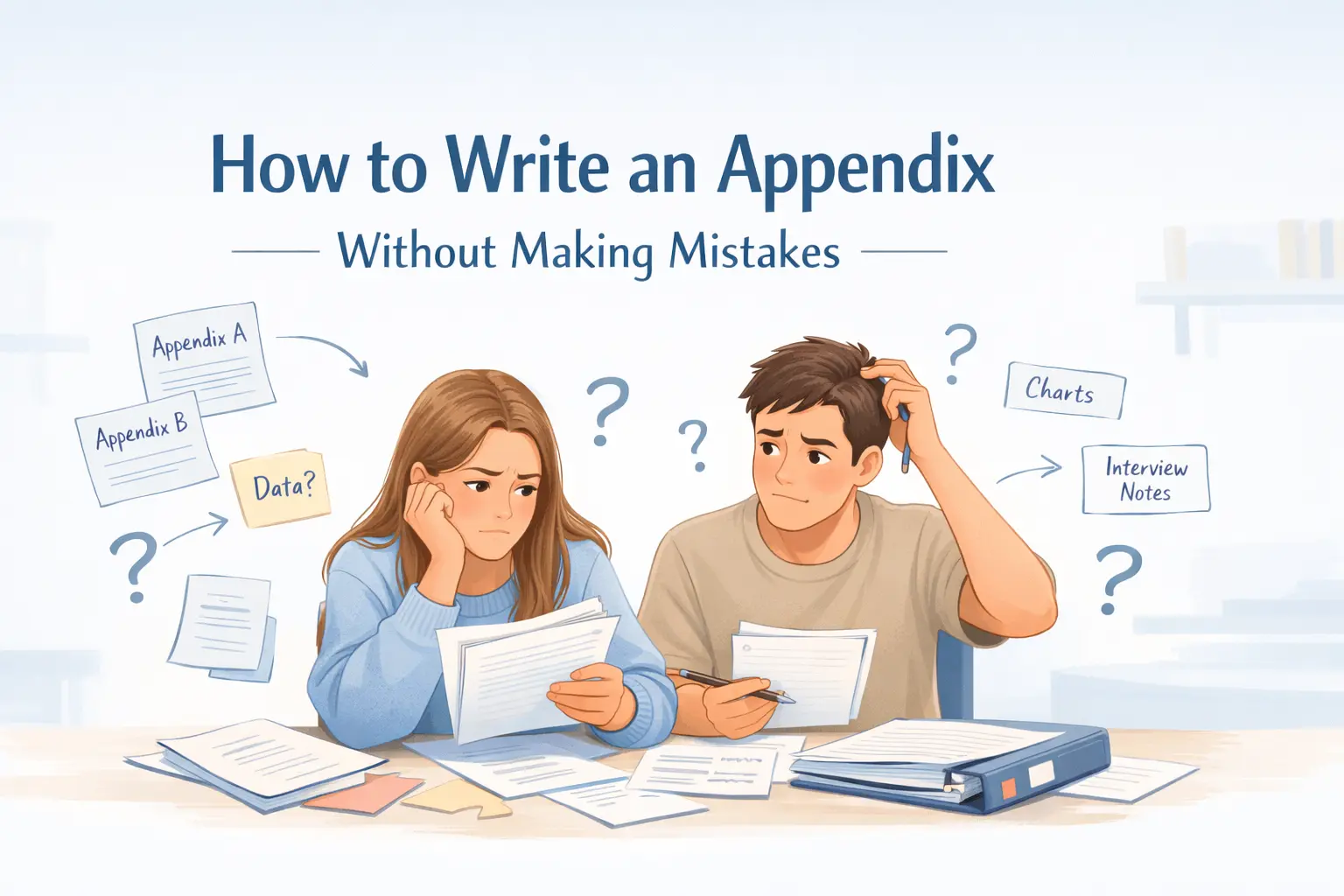
Every appendix starts on a new page. You should label them properly (Appendix A, Appendix B, Appendix C) or numerically according to your university’s established guidelines. Every label must have a title that explains to readers what they are viewing.
Appendix A: Participant Consent Forms
Appendix B: Raw Survey Data (October 2023)
Appendix C: Email Correspondence with Industry Experts
Maintaining this alignment is important for a high-grade submission. Most students find that assignment writing helpis invaluable for organizing the final pages. Professionals make sure that the layout is clean, fonts are consistent, and the page numbering continues logically from the main body.
The Importance of Cross-Referencing
The appendix becomes unnecessary when you fail to include it as a reference throughout your primary work. You need to “call out” the appendix at the exact point where the information needs to be used. The practice of referencing other sources for information purposes shows itself through this method. The supplementary work that you completed stays hidden from your invigilator until they reach the specific markers that you established.
How to Reference Correctly
When you mention a finding that’s supported by raw data, you should include a parenthetical reference. For instance: “The survey results indicated a 20% increase in staff morale (see Appendix B).” This tells the reader where to go to verify your sources.
Consistency in such references is a hallmark of professional academic writing. If you refer to “appendix 1” in one chapter and “appendix A” in another, you appear disproportionate. Taking appendix writing help guarantees that every cross-reference in your paper is accurate and functional. This attention to detail is what makes it apart from a distinction.
Handling Different Types of Content
Different data types need different formatting strategies to handle their specific requirements. The treatment of a photograph requires different methods than those used to handle a mathematical equation. Each element needs optimization for readability because examiners must assess evidence with quick access.
Formatting Tables and Charts
Tables in an appendix should follow the same style as tables in the main text. The tables need to display distinct labels for both their rows and their columns. Table headings need to be displayed again on each new page when tables extend across multiple pages. The arrangement of data prevents readers from needing to return to previous sections for better comprehension.
Incorporating Qualitative Data
If you are including interview transcripts, you must ensure they are readable. Your essay requires a clear font with line numbers when you intend to quote particular parts. The interviews require name redaction because they contain confidential details about participants.
Managing these technicalities is a significant burden during the final weeks of a project. Professionals like Assessment Help UK provide specialized support for these tasks. They help students format complex data sets so that they meet both aesthetic and ethical standards.
Avoiding Common Appendix Mistakes
Even top students make errors when finalizing their appendices. Project completion leads to errors that students make because they become tired. However, tutors use your appendix work to assess your complete ability to maintain precise work.
Mistake 1: Irrelevant Content
Some students include every piece of paper they collected during their research. The research method, which requires students to include all research materials they collected, is not correct. An appendix should only contain items that are directly cited in the text. The appendix should only contain material that you have not mentioned anywhere throughout your essay.
Mistake 2: Poor Image Quality
Blurry photos and unreadable handwritten note scans create an unprofessional appearance. The examiner requires high-resolution visual evidence to see all details of the presented evidence. Unreadable documents provide no research value to your work.
Mistake 3: Missing Page Numbers
Your Table of Contents needs to include the appendix section. The examiner will find it difficult to locate your evidence when your page numbers do not match the correct standards. This situation creates frustration, which results in decreased marks for presentation. Obtaining assignment writing help can prevent these “silly” errors from impacting your final grade.
The Role of the Appendix in Ethics and Transparency
British universities require academic integrity to be demonstrated through transparent procedures. The appendix serves as proof of your research activities. The inclusion of consent forms and raw data demonstrates that your research findings are authentic.
Demonstrating Ethical Compliance
If your research involved human participants, your appendix should include a sample of the information sheet and the consent form. The document serves as proof that you complied with the established procedures of the ethics committee.
- Documentation: Keep a clean copy of all ethical approvals.
- Anonymity: You must protect your raw transcripts from all forms of personal data disclosure.
- Verifiability: Your study needs sufficient data that enables other researchers to reproduce your results.
For students balancing work and study, this level of documentation is time-consuming. Seeking appendix writing help ensures that your ethical “paper trail” is complete and professional. It protects your academic reputation and ensures you meet all university regulations.
Practical Tips for Efficient Appendix Creation
You need to treat an appendix as an ongoing project instead of a final task, which needs to be completed in order to create a perfect appendix. You will spend less time on submission day panic when you collect your documents throughout the process.
- Create a Digital Folder: All charts, maps, and transcriptions should be stored in a dedicated file marked “Appendices” from day one.
- Standardize Your Files: You should convert all images into a single format path, which should be either JPEG or PNG. You should transform all text documents into PDF format. Word document format is also accepted as an alternative.
- Draft the Labels Early: Now that research results still lack complete evidence, one may use “Appendix A” and “Appendix B” as abbreviations, which will function as digital references throughout the document body.
If you find yourself overwhelmed by the volume of data, Assessment Help UK can assist in the curation process. They help you decide which pieces of evidence are strongest and how to present them most effectively.
Final Summary
The appendix functions as a strong tool that enhances the academic research standards of your work. The primary text delivers a complete argument that the examiner can evaluate using the small supporting evidence.
Your professional field demonstrates itself through your skill to organize items according to alphabetical order. The appendix functions as a vital part of your research narrative instead of being used to keep unnecessary material.
If the technical demands of formatting and referencing become too heavy, do not hesitate to seek appendix writing help. Utilizing professional resources is a hallmark of a successful student who is committed to excellence.